Payments Need Protection Too
Moving money has become faster and easier. Understanding what happens when a transaction goes wrong deserves just as much attention.
By Mira Tan
Moving money has become faster and easier. Understanding what happens when a transaction goes wrong deserves just as much attention.
Imagine paying a supplier you’ve worked with for months.
The invoice arrives, the amount looks right and the payment goes through. You receive a confirmation, forward it to your accounts team and get on with the rest of your day.
A few hours later, the supplier says the funds haven’t arrived.
Perhaps the payment was sent to the wrong destination. Perhaps something went wrong during processing. Or perhaps the transaction was completed exactly as instructed, but the commercial arrangement behind it has become disputed.
The confirmation screen offers little comfort at that point.
We’ve become remarkably good at making payments feel immediate. Digital wallets, instant-payment networks and stablecoins have reduced much of the friction involved in moving value. A transaction that once required several intermediaries and a considerable amount of waiting can sometimes be initiated and confirmed in seconds.
But faster payments have not made financial risk disappear.
In some situations, speed makes the question of protection more urgent. Once value has moved, recovering it may be difficult, especially when transactions cross financial systems or involve digital assets.
The next challenge for payment infrastructure is therefore about more than making money move. It’s about what happens when the transaction doesn’t go as expected.
A Successful Payment Isn’t Always a Successful Transaction
There’s a difference between completing a payment and completing the commercial obligation behind it.
A payment system may correctly execute an instruction while the buyer and seller still disagree about what was supposed to happen afterward.
Consider a business paying for goods that have not yet been delivered. The transfer may be technically successful, but the business still faces the possibility of non-delivery or a dispute over the transaction.
In another case, the payment itself may encounter an operational problem. Funds could be delayed, routed incorrectly or become subject to an exception that requires investigation.
These situations involve different risks, and they cannot all be solved with the same remedy.
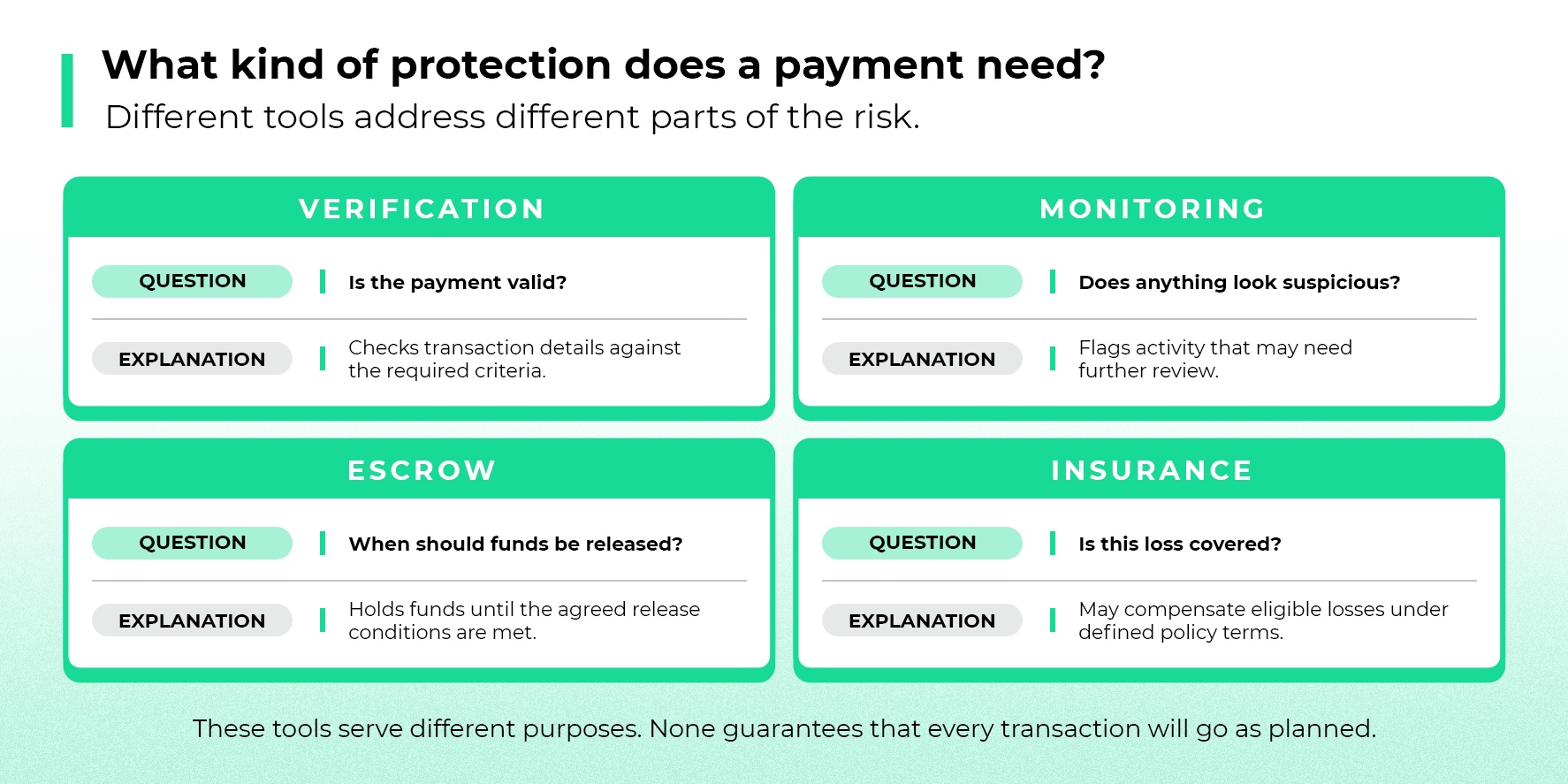
Payment verification helps establish whether an instruction is valid. Transaction monitoring can identify certain suspicious activities. Escrow arrangements may control when funds are released. Insurance, where available, can provide financial protection against specifically defined events.
Each serves a different purpose.
A secure payment system reduces the likelihood of certain problems. A protection mechanism addresses what happens if an eligible problem occurs anyway.
The distinction becomes more important as payments involve more currencies, networks and participants.
The Problem With Irreversible Payments
Traditional payment systems have developed different approaches to disputes, errors and unauthorized transactions. Depending on the payment method and applicable rules, customers may have access to reversals, chargebacks, investigations or other forms of recourse.
Those protections aren’t universal, and they don’t apply equally to every transaction.
Blockchain-based transfers introduce another set of considerations.
Once a transaction is finalized on a blockchain, it generally cannot be reversed simply because the sender changes their mind or discovers a mistake. Recovering funds may depend on the recipient’s cooperation or a separate legal or operational process.
That characteristic is useful for settlement certainty, but it can be unforgiving when something goes wrong.
Imagine sending a substantial stablecoin payment to a business counterparty. The transfer is confirmed, yet a dispute subsequently arises over whether the agreed transaction conditions were satisfied.
The blockchain can establish that value moved between addresses. It cannot, by itself, resolve every question about the commercial agreement.
The payment record is evidence of a transfer. It isn’t automatically evidence that every obligation connected to that transfer was fulfilled.
As stablecoins become more relevant to commerce, the distinction between transaction finality and transaction protection deserves greater attention.
What Would Protection at the Point of Payment Look Like?
Most people are familiar with insurance as something purchased separately from the activity it protects.
You buy travel insurance before a trip, insure a vehicle for a defined period or maintain business coverage against certain risks.
Transaction-level protection introduces a different possibility.
Instead of purchasing broad annual coverage, an eligible payment could have protection attached for the specific period during which a defined transaction risk exists.
Consider a company paying an overseas supplier. The relevant risk might exist between the moment funds are committed and the moment specified release conditions are satisfied.
A protection arrangement could be structured around that particular payment, with its own price, coverage period, conditions and claims process.
The important word is defined.
Insurance does not mean that every failed purchase, delayed payment or commercial disagreement automatically results in compensation. Coverage depends on the policy, exclusions, eligibility conditions and the circumstances of the event.
A transaction protection system must therefore do more than display a reassuring shield beside the payment button.
It needs to establish exactly what is protected, for how long, under which conditions and by whom.
Where APC Insurance Fits
APC Insurance is being planned as an additional transaction protection layer within APC’s payment ecosystem.
The proposed model focuses on eligible stablecoin transactions, with coverage priced and attached at the point of payment for a defined period. Rather than replacing the underlying payment network, the protection layer would operate alongside the transaction and settlement process.
Under the planned architecture, participating regulated insurance providers would supply the applicable insurance coverage, while APC would integrate the payment, transaction records and coverage-related infrastructure.
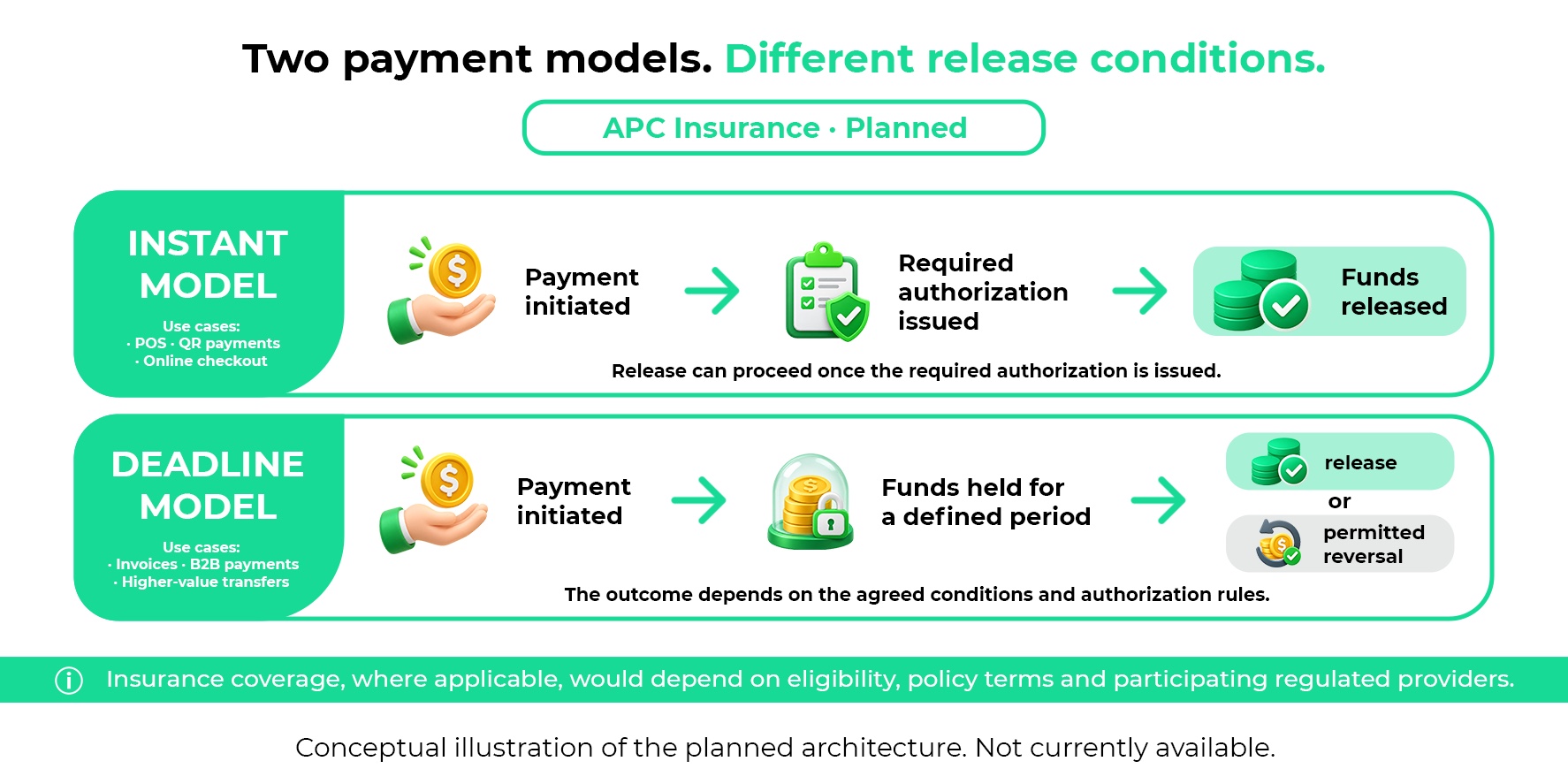
The whitepaper describes two initial payment structures.
An instant model is intended for environments such as POS, QR payments and online checkout, where release can occur once the required authorization is issued.
A deadline model is intended for transactions such as invoices, B2B payments and higher-value transfers, where funds may be held during a defined period and released or reversed according to the applicable conditions.
Both models depend on the precise transaction structure, authorization rules and coverage terms.
The initial technical scope described in the whitepaper focuses on USDC and USDT on Base L2, with other assets, networks and payment structures identified as possible future extensions.
APC Insurance remains a planned product. Its proposed coverage arrangements, participating providers and availability should not be interpreted as insurance services already offered to APC users.
The broader idea is to make protection part of the payment experience when the transaction and the applicable risk justify it.
Protection Needs Evidence
A useful insurance arrangement depends on being able to establish what happened.
That sounds obvious, but payments involving several systems can produce different records at different stages.
A transaction might have a payment instruction, an authorization record, a blockchain confirmation, a release event and a settlement record. If something goes wrong, those records may help establish which part of the process failed and whether the event falls within the relevant coverage.
The planned APC Insurance architecture includes traceable transaction, coverage, release, reversal and claim events.
Such records could help connect the payment lifecycle with insurance reconciliation and claims assessment.
They would not eliminate disputes or guarantee that every claim succeeds. They would, however, provide a more structured basis for determining what occurred.
For a business handling payments across several markets, that kind of traceability may be as important as the payment’s speed.
Protection Will Matter More as Commerce Changes
Payment risk is also likely to become more complicated as commerce becomes increasingly automated.
Today, a person usually makes the final decision to approve a purchase. Emerging AI-agent systems are being designed to initiate transactions within permissions established by users or organizations.
That introduces questions beyond whether the payment network can execute an instruction.
Was the transaction within the agent’s authorized budget? Was the correct counterparty selected? Were the required conditions satisfied? What happens if the automated purchase is technically valid but produces an unexpected commercial outcome?
Authorization controls and transaction monitoring will remain essential. Insurance may address certain eligible financial losses, but it cannot replace proper spending permissions, identity verification or operational safeguards.
These systems will need to complement one another.
A payment can be authorized correctly and still encounter a problem later. Understanding the difference between preventing a risk and providing protection against its consequences will become increasingly important.
Trust Doesn’t End at Confirmation
People rarely think about payment protection when everything works.
They notice it when money goes missing, a transaction fails or a dispute becomes difficult to resolve.
For businesses, those moments can have consequences beyond a single payment. Delayed funds affect cash flow. Unresolved disputes consume time. Uncertainty about financial recovery can make companies reluctant to adopt unfamiliar payment methods.
Digital assets and faster payment networks have made meaningful progress in moving value. The infrastructure around them must also address the risks that arise before, during and after settlement.
Not every transaction needs insurance, and insurance cannot eliminate every financial or commercial risk. The more useful objective is to make appropriate protections available where they can address clearly defined exposures.
A payment confirmation tells us that something happened within the payment system.
Trust depends on understanding what happens if the rest of the transaction doesn’t go according to plan.
About AIPaywithCrypto
APC connects digital assets with real-world commerce through consumer payments, merchant acceptance, online checkout and business settlement infrastructure. APC Agent Pay is in development, with a focus on authorized payments initiated by AI agents.
 Ai Pay With Crypto


