What Happens After You Tap “Pay”?
The payment confirmation is only the part we see. Behind a cross-border business transaction, routing, verification, liquidity and settlement determine whether the money reaches the right destination.
By Daniel Koh | Payment Education
The payment confirmation is only the part we see. Behind a cross-border business transaction, routing, verification, liquidity and settlement determine whether the money reaches the right destination.
Imagine a company in Singapore needs to pay a supplier in Thailand.
The finance team reviews the invoice, confirms the amount and authorizes the payment. Someone clicks “Pay,” and the system acknowledges the instruction.
From the sender’s perspective, the difficult part appears to be over.
The supplier, however, may not have received anything yet.
Between the payment instruction and the funds becoming available to the receiving business, several things may still need to happen. The transaction must reach the correct counterparty, satisfy applicable verification requirements, move through an appropriate payment route and, if necessary, be converted into the currency the supplier expects.
Some of these processes can happen quickly. Others depend on the financial systems involved.
It’s an important distinction because the confirmation that a payment has been initiated, or even authorized, doesn’t always mean the entire transaction has been settled.
For businesses operating across borders, understanding what happens after that first click can be just as important as making the payment itself.
The First Step Is an Instruction, Not a Transfer
When someone taps “Pay,” they are generally instructing a financial system to carry out a transaction.
That instruction contains information about the sender, the intended recipient, the amount and the payment method. Depending on the transaction, it may also include a currency, invoice reference or other information needed for processing.
The system then determines whether the instruction can proceed.
Is the sender authorized? Is the payment within the permitted limits? Is the receiving account or destination valid? Are additional checks required?
In a domestic consumer payment, much of this can happen so quickly that the customer barely notices.
International business payments can involve more participants and more complicated requirements. A payment between two companies may have to pass through different financial institutions, currencies and regulatory environments before reaching its destination.
That doesn’t mean every cross-border payment is inherently slow. It means the instruction is only the beginning of a process whose complexity depends on the route.
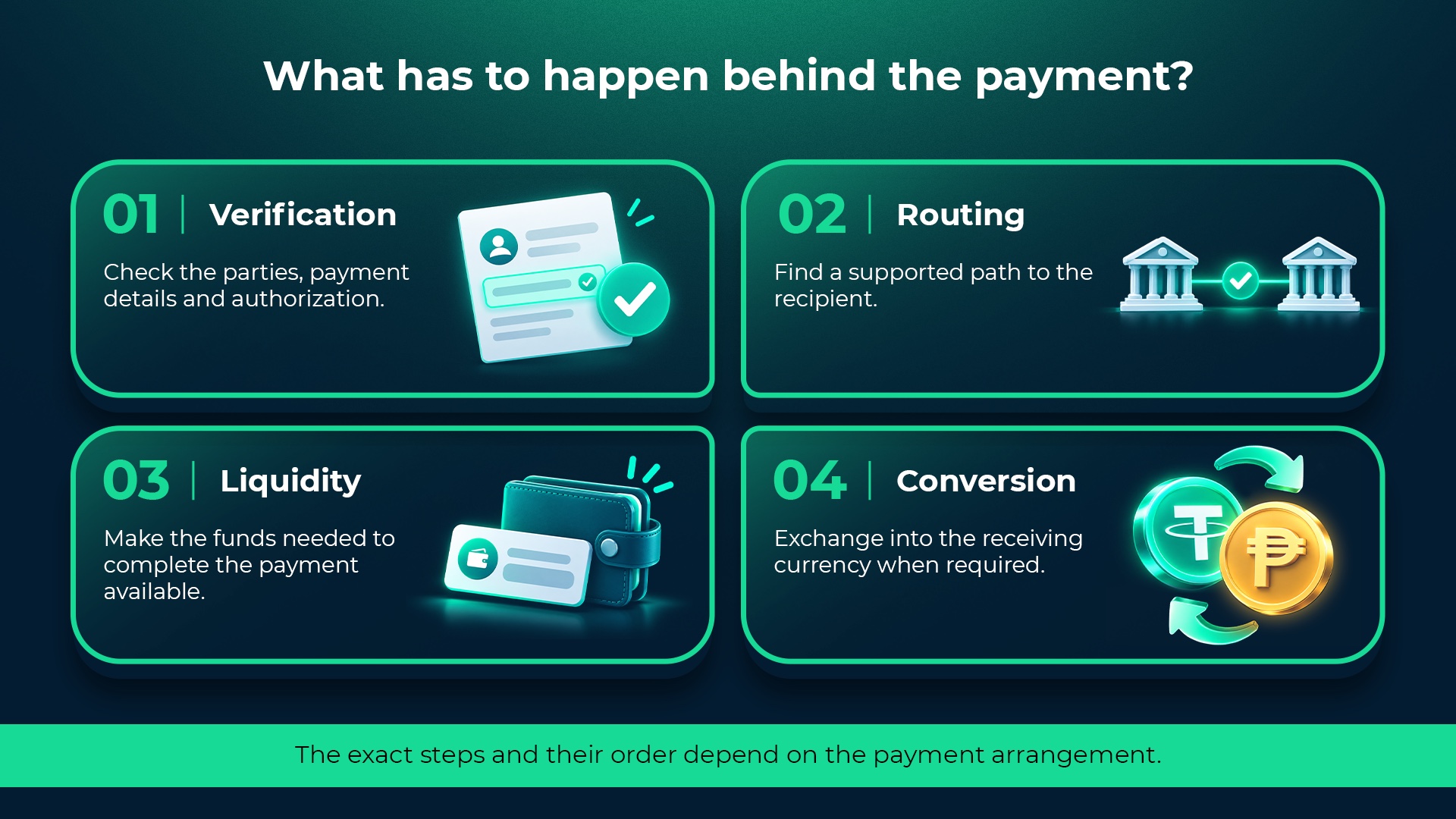
Verification: Making Sure the Payment Can Proceed
Before a transaction moves through a payment network, the relevant systems may need to verify the parties and the payment details.
For businesses, this can involve checks relating to identity, authorization, transaction limits, sanctions screening and other compliance requirements.
The precise checks depend on the institutions, jurisdictions and payment arrangements involved.
Consider a company paying an overseas supplier for the first time. The receiving business may already be known to the sender, but the payment providers handling the transaction still have their own responsibilities.
They cannot necessarily rely on the fact that two companies have agreed to do business.
Verification is sometimes treated as an inconvenience added to payment processing. In practice, it helps determine whether a transaction can proceed through the intended financial channels.
A payment system that moves funds quickly but cannot reliably establish who is sending or receiving them is not particularly useful for institutional commerce.
Routing: Finding a Way Through
Payment diagrams tend to make routing look simple.
There’s a sender on one side, a recipient on the other and an arrow between them. The arrow usually does a remarkable amount of work.
In reality, payment routing depends on the networks and financial relationships available to the transaction.
A cross-border payment might involve banks, payment service providers, local clearing systems or other authorized intermediaries. The route may also depend on the currencies involved and the destination’s payment infrastructure.
For example, a company paying a supplier in Thailand may need the transaction to reach a Thai financial institution or another supported local settlement arrangement.
The sender’s payment provider must have an appropriate way to reach that destination, whether directly or through connected participants.
A route that works for one country or currency may not work in another.
This is why global payment connectivity is more complicated than simply supporting a long list of countries. The practical question is whether the network can move value between specific counterparties under the conditions required by the transaction.
Liquidity: The Money Has to Be Available
Liquidity is one of those payment terms that sounds abstract until a transaction depends on it.
Suppose a company wants to pay an overseas supplier in local currency but holds its funds in a different currency or digital asset.
Completing the transaction may require a provider to access the appropriate funds or obtain the required currency.
That requires liquidity.
In traditional financial arrangements, institutions may maintain balances or access funding through banking and foreign-exchange relationships. In digital-asset payment arrangements, liquidity providers and conversion services may help bridge the funding asset and the recipient’s required currency.
Either way, the payment needs more than a message saying money should move.
There must be a viable financial arrangement supporting that movement.
For businesses handling significant transaction volumes, liquidity can affect how reliably payments are completed, what they cost and which corridors are available.
It’s rarely the most visible part of a payment service, but it can be one of the most consequential.
Conversion: What You Send May Not Be What They Receive
A company may hold USDT while its supplier expects Thai baht. Another business may initiate a payment in US dollars while the receiving counterparty needs Philippine pesos.
The sender and recipient don’t necessarily operate in the same currency.
When conversion is required, the transaction needs an exchange rate and an arrangement for delivering the appropriate currency.
The timing of that conversion matters. So do the applicable fees and the way the exchange rate is established.
Imagine approving a payment based on one quoted amount, only to discover that the recipient will receive less than expected because of conversion costs that weren’t clear at the beginning.
For a consumer making a small purchase, the difference might be inconvenient. For a business settling a substantial supplier invoice, it can create reconciliation problems or leave an outstanding balance.
A well-designed payment process should make the relevant pricing and conversion conditions clear before the transaction is executed.
Stablecoins introduce useful possibilities here because they can provide another way to move value between financial participants. But a stablecoin transfer doesn’t automatically solve the problem of delivering local currency to a business that needs it.
Conversion remains part of the payment whenever the sending and receiving environments require different forms of value.
Settlement: When the Payment Reaches Its Destination
Eventually, the transaction must produce the outcome both parties expected.
The receiving business needs the funds to arrive through the appropriate financial arrangement and become available under the applicable settlement terms.
This is where the distinction between payment authorization and settlement becomes particularly important.
A transaction may be authorized before the receiving institution obtains the relevant funds. A digital-asset transfer may be confirmed on a blockchain before a separate local-currency payout is completed.
Those events can be connected without being identical.
For businesses, the final settlement result affects more than the payment record. Settlement status helps businesses track completion of a payment. When the recipient can use the funds, reconcile the invoice and consider the obligation fulfilled also depends on account availability, payment records and the agreed terms.
A supplier waiting for payment may have employees, logistics providers and other obligations of its own.
The sender’s successful payment notification is useful information. The recipient’s confirmed settlement is what allows the commercial relationship to move forward.
Where APC Settlement Fits
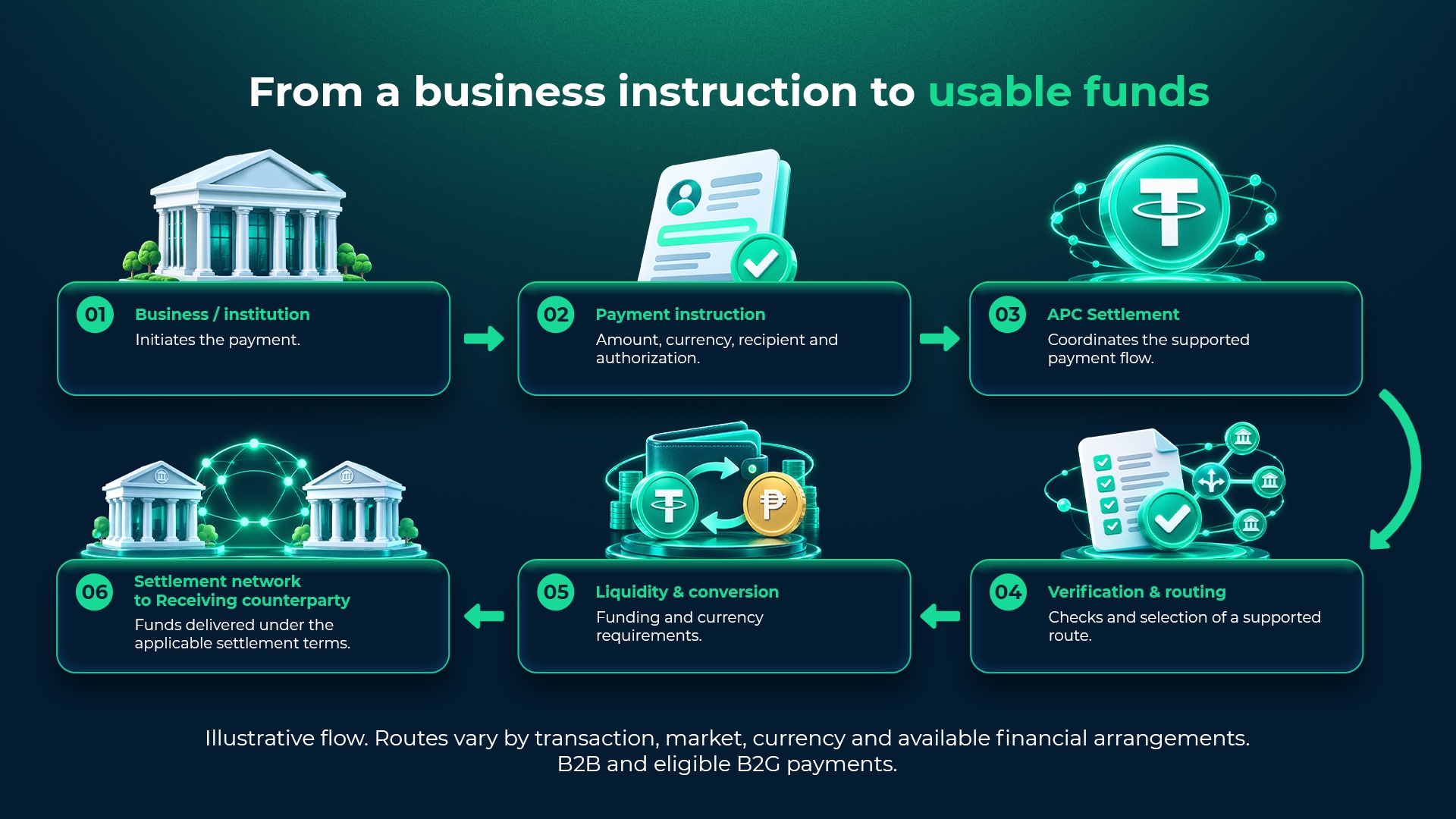
APC Settlement supports cross-border business and institutional payments, including business-to-business (B2B) and eligible business-to-government (B2G) transactions.
Rather than being simply the final processing step behind a consumer checkout, APC Settlement is designed for payment environments involving companies, institutions, suppliers, business partners and government counterparties.
Its infrastructure model connects payment instructions with verification, routing, liquidity, conversion and settlement through supported financial networks.
The actual route varies according to the transaction, supported markets, currencies and available financial arrangements. Not every payment requires every step in precisely the same form.
For a business trading internationally, the value of connected payment infrastructure lies in making these processes work together.
A company might pay a supplier in one country, settle with a distributor in another or make an authorized payment to a government institution. Each relationship has different requirements, but all depend on the ability to deliver value to the intended recipient.
That is the practical problem APC Settlement is designed to address.
A Faster Payment Isn’t Always a Better Payment
Payment technology companies often compete on speed, and understandably so.
Nobody wants a payment to take longer than necessary.
But speed alone is an incomplete measure of payment performance.
A transaction that reaches a blockchain address in seconds may still require conversion before the receiving business can use the funds. A payment instruction may be processed immediately while settlement depends on additional financial arrangements.
Businesses also care about predictability.
They need to understand how much the recipient will receive, which costs apply, whether the payment can be completed through the intended route and how its status will be reported.
A slightly slower transaction with clear pricing and reliable settlement may be more useful than a faster transfer that leaves the receiving business uncertain about when its funds will become available.
The important measurement is the outcome of the complete payment, not just the speed of its first stage.
The Part of the Payment We Rarely See
Most people will never need to think about payment routing or liquidity when buying something online.
That’s a reasonable expectation. Payment infrastructure should handle its complexity without passing every technical detail to the customer.
Businesses operating across borders, however, have more reason to understand what happens behind the confirmation screen.
Their payments can involve multiple currencies, financial institutions, settlement networks and regulatory environments. The transaction’s success depends on how those systems work together.
Digital assets, stablecoins and newer payment technologies can improve parts of that process. They create additional possibilities for moving value and connecting financial environments that have traditionally operated separately.
Yet the commercial requirement remains familiar.
Someone owes money. Someone else needs to receive it.
Everything between those two facts is payment infrastructure.
And when a business taps “Pay,” the transaction has only done its job once the value reaches the other side in a form the recipient can actually use.
About AIPaywithCrypto
APC connects digital assets with real-world commerce through consumer payments, merchant acceptance, online checkout and business settlement infrastructure. APC Agent Pay is in development, with a focus on authorized payments initiated by AI agents.
 Ai Pay With Crypto


